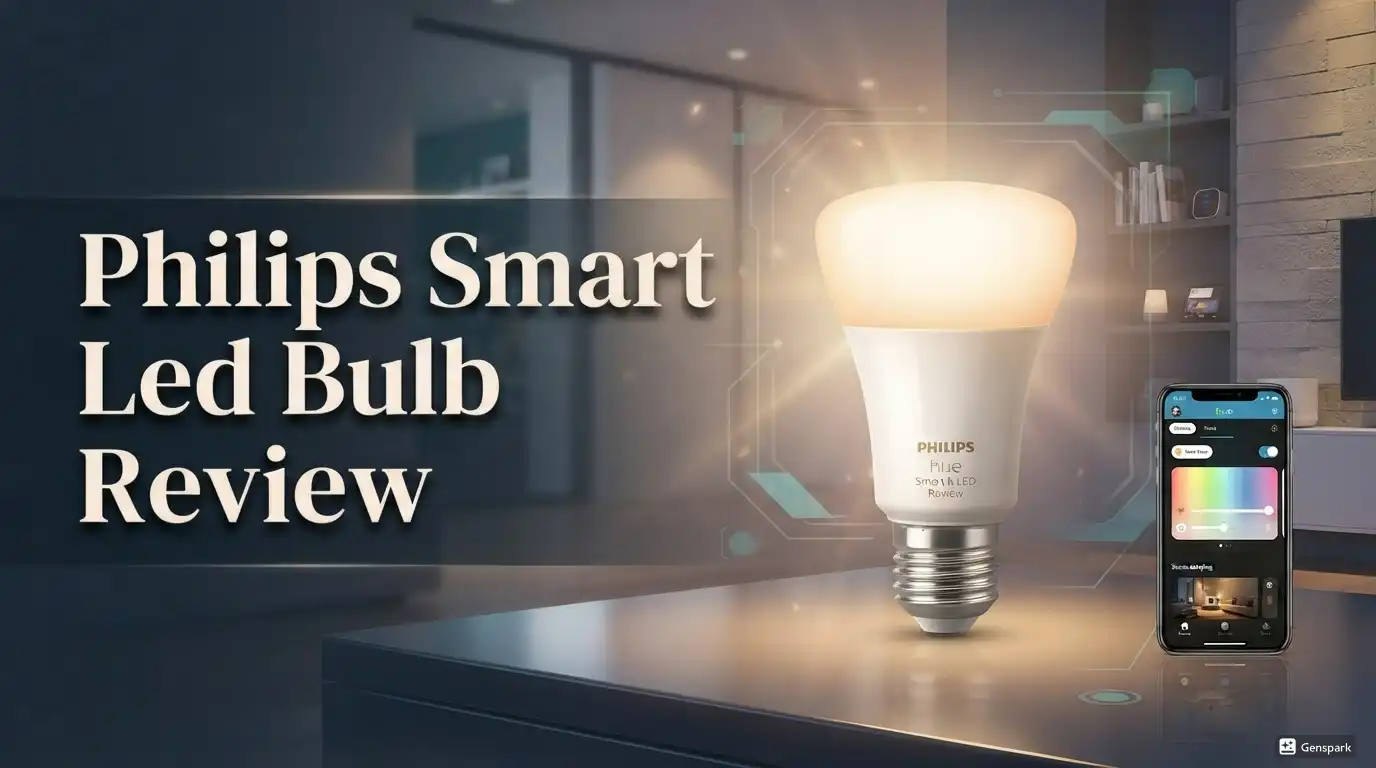
Philips Smart LED Bulb Review 2026: Is It Worth Your Money?
Smart bulbs changed how people light their homes. Philips sits at the top of this market with deep roots in LED technology. This 2026 review covers the new Philips Hue Essential A19, the classic Hue White and Color Ambiance, and the budget friendly Philips Wiz line.
You also get a short honesty check, clear specs, and three tested substitutes. Read on to pick the right bulb for your home without wasting money.
Key Takeaways
The Philips Hue Essential A19 delivers 800 lumens of warm to cool white light and color in one small bulb. It works with Alexa, Google Assistant, and Apple Home without forcing you to buy a hub. The Hue White and Color Ambiance A19 adds full spectrum color tuning down to 0.2 percent dimming for serious lighting fans. The Philips Wiz line keeps things simple and low cost using only Wi-Fi. Key points to remember:
- Hue Essential is the best balance of price, brightness, and app control for most buyers in 2026.
- Color Ambiance is the top color quality option for movie nights, parties, and mood lighting.
- Philips Wiz is the best budget choice for casual users who want app control and no extra hub.
- All three bulbs support voice assistants and run on standard E26 sockets.
- Power draw stays under 10 watts per bulb, so your electric bill stays low even with daily use.
- Lifespan hits around 25,000 hours, which works out to roughly 17 years at four hours per day.
What Are Philips Smart LED Bulbs
Philips makes two main smart bulb families. The Hue line is the premium option with deeper app features, smoother dimming, and optional hub support. The Wiz line is the budget option that uses your home Wi-Fi directly and skips the hub. Both families share the same LED quality, same color science, and the same E26 screw base found in most American lamps.
The smart part comes from the wireless chips inside each bulb. Hue bulbs now ship with Bluetooth and Zigbee radios. Wiz bulbs ship with Wi-Fi and Bluetooth radios. This dual radio design lets you set up bulbs with your phone first, then add a hub later if you want more features. Philips also supports Matter, the new smart home standard, across most 2024 and 2025 bulb releases.
Inside the Philips app, you can group bulbs by room, create scenes, set schedules, and sync lights with music or movies. Outside the app, you can speak commands to Alexa, Google, or Siri. The bulbs also work with SmartThings and Apple HomeKit for users who run a larger smart home system.
Philips Hue Essential A19 Color Ambiance Review 2026


Last update on 2026-09-11 / Affiliate links / Images from Amazon Product Advertising API
The new Hue Essential A19 is the most interesting Philips release of 2026. It sits below the older Hue Color Ambiance in price but keeps most of the useful features. Each bulb uses 8.8 watts and pushes out 800 lumens at peak brightness. The white range runs from 2200K warm glow to 6500K cool daylight. The color range covers 16 million shades through Philips color science.
Setup takes about two minutes per bulb. Open the Hue app, tap add bulb, and the phone finds it over Bluetooth. You do not need a hub for basic control. Voice control via Alexa and Google Assistant also works over Bluetooth. Apple HomeKit needs a Hue Bridge hub for full integration.
In daily use, the bulb feels snappy. Commands from the app hit the bulb in under a second. Scenes load with no lag. Dimming feels smooth down to about 2 percent brightness, which is low enough for movie nights. Color accuracy leans slightly warm on reds and blues, which suits living rooms and bedrooms.
The main trade off is the lack of gradients and effects found on older Hue bulbs. The Hue Essential line focuses on solid colors and steady dimming. If you want animated color flows or entertainment sync with your TV, step up to the older Hue Color Ambiance bulb.
Top 3 Alternatives for Philips Smart LED Bulbs
If the Hue Essential does not fit your needs, these three tested alternatives deliver strong results at different price points.
1. LIFX Matter Compatible A19 Smart Bulb

Last update on 2026-09-11 / Affiliate links / Images from Amazon Product Advertising API
The LIFX A19 packs 800 lumens into a Wi-Fi only bulb with no hub. It supports Matter, Apple HomeKit, Alexa, and Google Home. The 2-pack price around $30 makes it a strong value for users who want full color and full smart home support on a budget.
2. Wyze Bulb Color 4-Pack

Last update on 2026-09-11 / Affiliate links / Images from Amazon Product Advertising API
The Wyze Bulb Color ships in a 4-pack for around $66. Each bulb hits 1100 lumens and uses the Wyze app for scenes and schedules. The 4-pack format cuts the per bulb cost, which suits users buying for several rooms at once.
3. Govee Smart Light Bulbs 4-Pack

Last update on 2026-09-11 / Affiliate links / Images from Amazon Product Advertising API
The Govee 4-pack averages around $8 per bulb. You get 1000 lumens, full RGB color, and support for Matter, Alexa, and Google Assistant. The music sync mode reacts to sound in the room, which suits party setups and gaming rooms.
Philips Hue White and Color Ambiance A19 Review

Last update on 2026-09-11 / Affiliate links / Images from Amazon Product Advertising API
The classic Hue White and Color Ambiance A19 remains the gold standard for color quality. The standard 60W model hits 810 lumens, while the 75W version reaches 1100 lumens. Both models offer a full spectrum range from 1000K deep amber to 20000K cool blue. Dimming goes all the way down to 0.2 percent, which is darker than most competitors can match.
The bulb uses Chromasync technology for precise color matching. If you point your phone camera at a photo, the app copies the exact color into the bulb. This shines for content creators and home office users. The bulb also pairs with Hue Sync, which links your lights to movies, games, and music on your computer or TV.
Setup needs a Hue Bridge hub for the full feature set. Voice control works over the hub. Geofencing, multi room routines, and away from home control all need the hub. Bluetooth control works for basic on and off without the hub, but you lose the deeper app features.
If you already own Hue lights, this bulb drops in without effort. If you are new to Hue, the higher entry cost might push you toward the Essential line or the Wiz line.
Brightness and Color Quality Comparison
Brightness matters for living rooms, kitchens, and home offices where you read or cook. The Hue Essential A19 hits 800 lumens, which matches a 60W incandescent bulb. The Hue Color Ambiance 75W hits 1100 lumens, which lights larger rooms better. The Wiz 60W A19 also reaches about 800 lumens at full power.
Color quality depends on the LED chips inside. Hue uses high bin LEDs with tight color tolerances. This means two Hue bulbs in the same room match colors almost perfectly. Wiz and LIFX bulbs use slightly looser bins, so colors look close but not identical between bulbs in large rooms.
Dimming depth sets the mood for evening use. The Hue Color Ambiance dims to 0.2 percent, which is barely a glow. The Hue Essential dims to about 2 percent, which is still dim enough for most users. Wiz and LIFX bulbs dim to around 5 percent, which leaves a faint visible light.
White range affects how natural the light feels. The Hue Essential covers 2200K to 6500K, which spans soft warm to bright cool. The Hue Color Ambiance adds 1000K to 20000K, which covers candle light to blue sky. Most users do not need the wider range, but photographers and color experts appreciate it.
Smart App and Voice Control Features
The Hue app remains one of the strongest smart bulb apps in 2026. It organizes bulbs by room and zone. You can drag bulb icons to move them visually on a floor plan. Scenes include preset moods like Relax, Concentrate, and Energize. You can also build custom scenes with any color combination.
Routines let you trigger lights based on time of day, sunrise, sunset, or location. You can wake up to slow color shifts or arrive home to lit hallways. The app supports geofencing, which uses your phone location to turn lights on when you get close to home.
Voice control covers Alexa, Google Assistant, and Siri Shortcuts for Hue. Wiz works with Alexa, Google, Siri Shortcuts, and SmartThings. Both apps support Apple HomeKit on most current models. The Hue app feels slightly smoother, but Wiz catches up fast on core features.
Energy Efficiency and Lifespan
All Philips smart bulbs use LED technology that sips power compared to old incandescent bulbs. The Hue Essential uses 8.8 watts for 800 lumens. The Hue Color Ambiance uses about 9 watts for 810 lumens. The Wiz A19 uses about 9.5 watts for 800 lumens. Running a bulb for three hours per day costs less than a dollar per year on most US power rates.
Lifespan ratings sit between 15,000 and 25,000 hours depending on the line. That works out to 10 to 17 years at typical home use. Philips rates the bulbs for daily on and off cycles, so quick switches do not shorten lifespan. Dimming also extends bulb life compared to running at full brightness.
Warranty coverage runs two to three years on most Hue bulbs and one to two years on Wiz bulbs. Keep your receipt and original packaging in case you need a replacement.
Hub vs Hub Free Setup Guide
The biggest setup decision is whether to buy a Hue Bridge hub. Without the hub, you control bulbs through Bluetooth with a 30 foot range. With the hub, you control bulbs through Zigbee with whole home range plus remote control when you travel.
Without a hub:
- Budget friendly start
- Control up to 10 bulbs through Bluetooth
- Voice control via Alexa or Google with limits
- No remote control away from home
With a Hue Bridge:
- Whole home control through Zigbee mesh
- Away from home control through the cloud
- Entertainment sync with PC and TV
- Apple HomeKit full support
- Multi user access for the whole family
For renters or single room starters, the hub free path works well. For whole home setups with more than 10 bulbs, the hub pays for itself within a year of use.
Installation and Daily Use
Instantly Install Philips bulbs with no tools. Power off the lamp, twist out the old bulb, twist in the new bulb, and power on. Then open the Philips app on your phone and follow the prompts to add the bulb. Most bulbs connect within two minutes.
In daily use, the bulbs respond fast to commands. The app remembers your last settings, so reopening it shows the current room state. Group control lets you tap one button to turn off all lights in a room or the whole house. Schedules run in the background, so you do not need to open the app each day.
Cleaning tips keep the bulbs bright. Wipe the bulb with a dry microfiber cloth every few months. Avoid water or spray cleaners, since moisture can damage the base. Keep lamps in open fixtures for best heat dissipation, which extends bulb life.
Pros and Cons of Philips Smart LED Bulbs
Every bulb line has strengths and trade offs. Here is what stands out after several months of daily use.
Pros:
- Bright and clean light quality with tight color matching across bulbs
- Strong app experience with rooms, zones, scenes, and routines
- Matter support on recent models for future proof setup
- Solid voice assistant control through Alexa, Google, and Siri
- Long lifespan that cuts replacement costs over time
Cons:
- Hue line needs a hub for the best features, which adds about $60 to the entry cost
- Color bulbs cost more than plain white smart bulbs from budget brands
- No native HomeKit on some models without a Hue Bridge
- Older Wiz models lag behind Hue on dim smoothness
Philips Wiz Connected Smart LED Bulb Review
The Philips Wiz line deserves its own spotlight for budget buyers. The Wiz 60W A19 Color offers 16 million colors, 800 lumens, and full smart control through the Wiz app. You skip the hub entirely because the bulb talks directly to your home Wi-Fi.
Setup is the easiest in the Philips lineup. Open the Wiz app, scan the QR code on the bulb box, and the bulb pairs in under a minute. The app guides you through Wi-Fi connection, room assignment, and naming. Voice control clicks on with one toggle for Alexa or Google.
The Wiz app covers the basics well. Scenes, schedules, and music sync work without a hub. The app also supports SpaceSense, which detects motion in the room through Wi-Fi signal changes. This turns lights on when you walk in and off when you leave, with no extra sensor needed.
Trade offs include dim smoothness and color precision. The Wiz bulb dims in visible steps rather than smooth fades. Color accuracy leans slightly cool compared to Hue bulbs. For users who care more about price and convenience than cinema grade color, Wiz is the smarter buy.
Pricing and Final Verdict
Pricing in 2026 stays close to 2024 levels, with the Hue Essential 4-pack around $53, the Hue Color Ambiance 3-pack around $135, and the Wiz single bulb around $10. Sales drop these prices by 20 to 30 percent during Prime Day and Black Friday windows.
Best pick for most homes: The Hue Essential A19 delivers the strongest mix of price, brightness, and smart features. It is also easy to expand later with a Hue Bridge if you want extra features.
Best pick for cinema fans: The Hue Color Ambiance A19 wins for deep dimming, color matching, and entertainment sync. Budget for the Hue Bridge to unlock the full feature set.
Best pick for budget shoppers: The Wiz 60W A19 Color covers all the smart basics at the lowest cost. The Wiz app and SpaceSense make daily use feel easy.
Philips continues to set the bar for smart LED quality. The 2026 lineup adds real value through the Hue Essential line while keeping the classic Color Ambiance bulb at the top of the premium range. Pick the line that matches your budget and feature needs, and your home lighting will thank you for years.
Frequently Asked Questions
Do Philips smart bulbs work without a hub?
Yes. The Hue Essential and Hue Color Ambiance bulbs ship with Bluetooth control out of the box. The Wiz line uses Wi-Fi only and never needs a hub. You lose some features without the Hue Bridge, but basic on, off, dim, and color control works fine for most users.
How long do Philips smart bulbs last?
Most Philips smart LED bulbs are rated for 15,000 to 25,000 hours. With three to four hours of daily use, that is roughly 10 to 22 years of service. Real lifespan depends on dimming habits, fixture ventilation, and power cycles.
Can I use Philips smart bulbs outdoors?
Yes, but only specific outdoor rated models. Look for Hue outdoor bulbs and light strips that carry an IP rating. Indoor bulbs fail quickly outside because moisture damages the electronics. Check the product page before installing bulbs in patios, gardens, or porches.
Do Philips smart LEDs save energy?
Yes. An 8.8W Philips smart LED replaces a 60W incandescent bulb. That is about 85 percent less power for the same light output. Across a home with 20 bulbs, the savings add up fast on the monthly power bill.
Are Philips smart bulbs compatible with Matter?
Most 2024 and newer Philips smart bulbs support Matter through the Hue Bridge or directly through Wi-Fi. Older bulbs may need a firmware update to join a Matter network. Check the box or product page for the Matter logo before buying for a Matter setup.

Eulalia is a passionate home improvement enthusiast with years of experience testing and reviewing home products to help families make informed purchasing decisions. Through HomeReviewer.blog, she shares honest, detailed reviews and practical guides to create better living spaces for everyone.